

 0
0


How to identify a Banarasi saree real or fake
January 13, 2026 — 6 minutes read
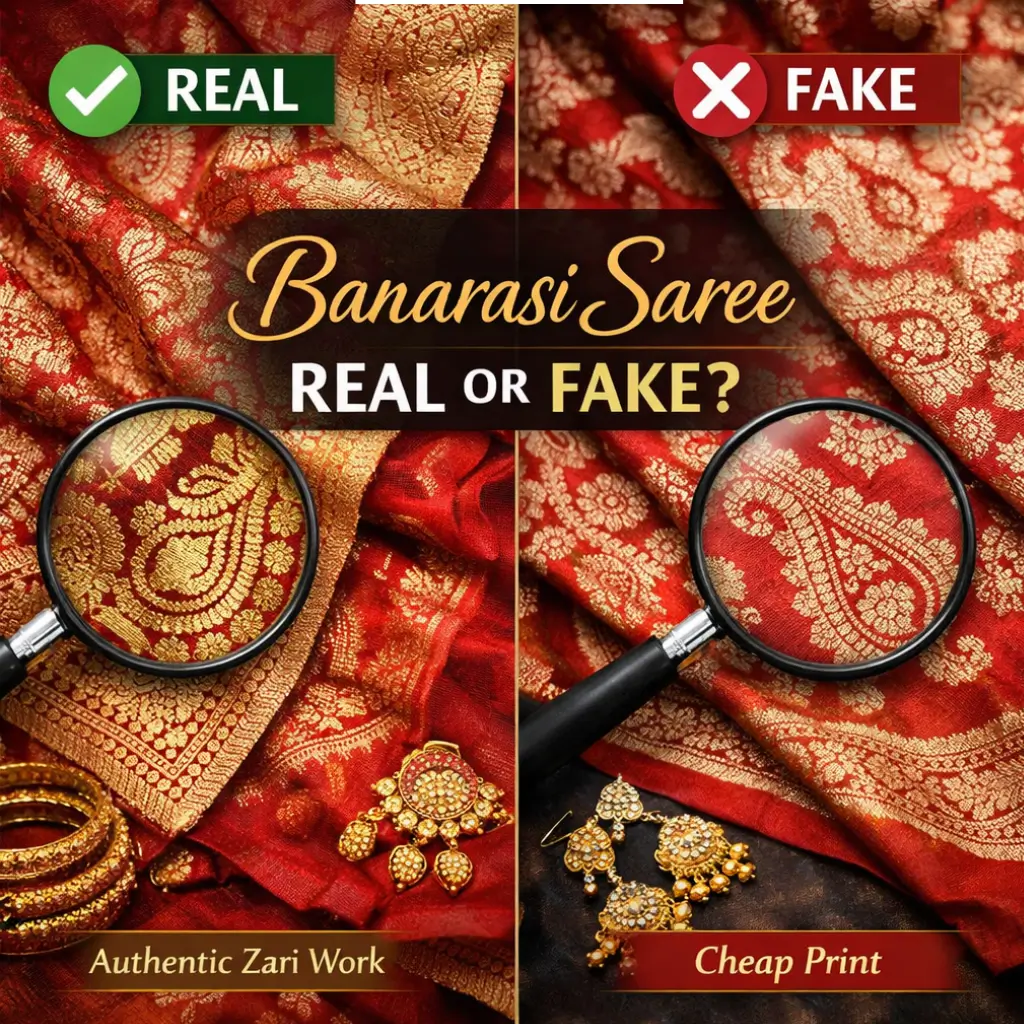
It is every girl’s dream to own an original Banarasi saree. Without it, an Indian heritage wedding feels incomplete.
People often come to us and ask,
“Banarasi sarees are easily available in the market for $30, so why are some Banarasi sarees so expensive?”
You need to understand that if a Banarasi saree is original, there is a reason why it is expensive, and you also need to ask yourself whether you are paying the right price.
It is not the case that you are paying the original price and receiving something else in return.
Because the look of an original Banarasi saree can never be achieved in $30-$50.
Today, I will tell you a few ways through which you can understand at once whether your saree is:
- an original Banarasi
- power-loom made
- or artificial
So, let’s get started.
Identify a real Banarasi saree with its technique
Kadhua Weaving Technique
First, let’s talk about the basic weave techniques used to make Banarasi sarees. The first one is the Kadhua weaving technique.
The Kadhua technique is impossible to copy. It cannot be made on power looms or machines; it is made only on handlooms. That’s why almost 99% of the Kadhua sarees you find are real.
Check the image below and explain what makes it special.
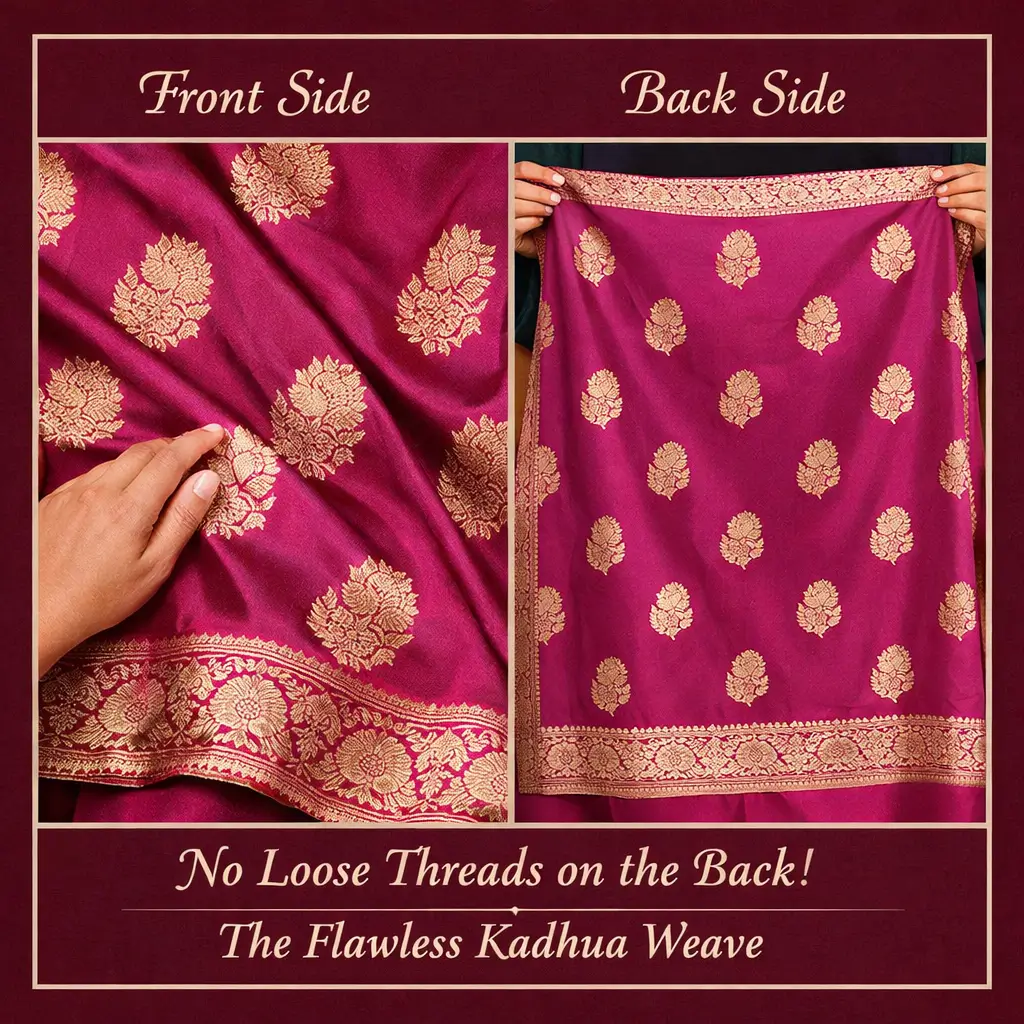
Look closely at the front side of the saree as well as the back side, and you’ll notice that there isn’t even a single loose thread. No thread has been cut or left hanging.
This is why it is called Kadhua, and this is also why this technique is so famous.
It takes around two months to perfect this technique.
Making this saree requires two weavers so that the same design and the same type of threads can be worked into the saree properly.
If I talk about most Banarasi sarees today, many of them are made using this Kadhua technique.
Cutwork Technique
Now let’s talk about the second technique, which is called Phekua, which is called Cutwork in English.
Most of the copied Banarasi sarees available in the market are made using this technique.
But that does not mean this technique is bad. It’s actually unfortunate that our handloom designs are copied and sold as cheaper products.
Cutwork is easier to copy, which is why fake Banarasi sarees are mostly made using this method.
Otherwise, this technique is also very good, and you can buy sarees made with it.
Now check the image below to see the difference between these two techniques by looking at the back side of the saree.
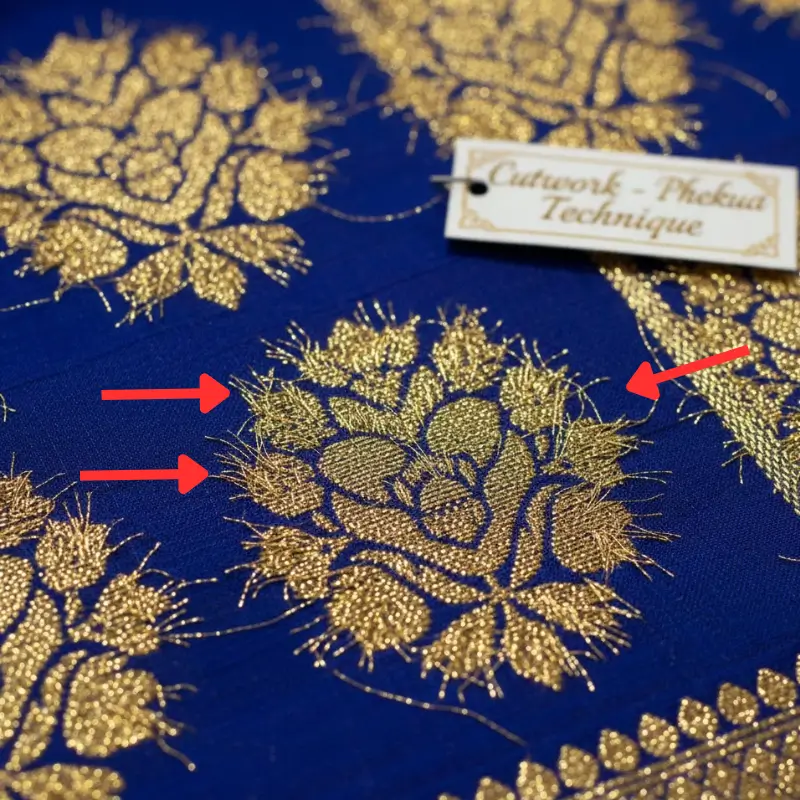
In a cutwork saree, you’ll see that all the design threads are cut at the back. That’s why it’s called cutwork.
In Kadhua, the design is woven into the saree, whereas in cutwork, the threads are cut after the design is made.
Sometimes, you’ll see very heavy sarees where the threads are left open at the back and not cut. That is also considered a type of weave.
Now let’s move ahead.
Did you know that Banarasi sarees are made in pure silk, semi-silk, and artificial fibers as well?
Let me explain the difference between all three.
- In a pure silk saree, both the warp and weft are silk.
- In semi-silk (art silk), the design threads are silk, while the remaining threads are polyester or art silk.
- In an artificial saree, both warp and weft are polyester (nylon).
Such sarees are easily available in the market for around $20 to $30.
Now let’s talk about some easy techniques through which you can identify whether your saree is a real Banarasi or a fake one.
Techniques to identify a real Banarasi saree
Identify the Quality of Zari
In an original Banarasi saree, the zari used contains at least 8.5% silver content. On top of that, it is coated with a golden polish, which makes the zari very strong.
When worn during festivals like Diwali or at weddings, this zari does not break easily.
On the other hand, nylon or artificial zari is commonly used, which lacks strength and gets damaged quickly.
When we talk about pure silk, you will clearly notice a silver or golden shine in the zari.
This is because pure silk is made from protein fiber, which gives a very soft, smooth, and rich look.
In contrast, power-loom or artificial sarees are made from synthetic fibers, which do not provide the same richness.
Pin-hole test
Check the corners of the saree for small pin-hole marks. If you see these marks, it means the saree was made on a handloom.
When a saree is woven on a handloom, pins are fixed on both sides to hold the threads. These marks can still be seen even on 20–25-year-old sarees.
Check the zari direction
If the zari thread runs across the width, the saree is handloom-made. If the zari runs along the length, the saree is machine-made.
This is a very important difference that helps identify the weaving method.
Burn test
When an artificial thread is burned, it smells like plastic and melts or sticks together. Pure silk burns quickly, forms soft ash, and smells like burnt hair.
Weight test
A pure silk saree is heavier compared to an artificial or semi-silk saree.
Natural Fiber Test (Sound & Feel Test)
Natural fibers:
- are very soft
- do not make much sound
- are comfortable to wear
Artificial fibers:
- feel slightly hard
- make noise when rubbed
- lose their shape quickly
This is a very important test and can be done easily at home.
Touch test
Pure silk feels very soft and smooth to touch, while artificial sarees feel comparatively hard or rough.
Strength and Longevity Test
An original pure silk Banarasi saree:
- does not tear easily
- can last 2–3 generations if maintained properly
Whereas artificial sarees:
- weaken quickly
- do not last long
A pure handloom Banarasi silk saree gives a royal and authentic look at any wedding function.
Sound test
Artificial sarees make a strange noise when rubbed or handled.
Pure silk sarees do not make such sounds.
Conclusion
A handwoven pure silk Banarasi saree:
- introduces itself
- does not require any test to prove its authenticity
If you pay attention to these small details,
You will easily understand:
- which saree is worth its price
- and how much you should actually pay for it
Using these methods, you can easily identify whether your saree is pure or fake.
Subscribe to new posts
